24 men and women from the University of Michigan and 20 translators from the La Unión bilingual school hiked all throughout each one of La Unión's 32 aldeas to survey each and every adult. The team was led by principal investigators, Derek Stafford (University of Michigan) and D. Alexander Hughes (University of California San Diego.) The field organizers were Andrew Boyd, Michael De Wit, Patrick Hughes, and Daniel Schwartz; all of whom are now part of the UMF Team.
The surveys were conducted and compiled using Netriks, a computer program developed by software engineer, Bret Abel; also a current member of the UMF team. Indeed, without the hard work of every single member of the research team, we would not have been able to do what we did, and UMF would not be what it is today.
Before we even stepped foot in Honduras, we spent many months preparing for the study. From developing the survey program, creating the actual survey, considering cultural context, to handling travel logistics, we spent a lot of time making sure we could have the greatest success possible when we would actually arrive in Honduras.
When the time finally came, the research team flew down to Honduras and piled into an old yellow school bus awaiting us at the airport. After a five hour drive over dirt, mountain roads in the western highlands, we arrived at our home-base, a missionary compound in the village of La Unión. After settling in, learning the dos and don'ts of rural living, familiarizing ourselves with the local cuisine, meeting our team of translators, and getting to know the village and the surrounding aldeas, we felt ready get out and do what we came for.
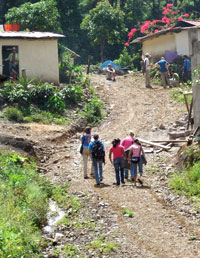
In the aldeas, we would break up into survey teams consisting of a field leader, several surveyors, and translators. No maps existed of the aldeas, so we made them ourselves. We then used these maps to make sure we visited every house, where we recorded the name and took a photograph of every adult. These pictures were then uploaded into the Netriks survey program.
Using these pictures for identification, we ran the survey phase of research. We revisited every person of every house and asked a series of questions, both about themselves and about their relationships in the community. The pictures were vitally important for the key survey questions: the ones about family, friends, and negative affective relationship networks. Pictures helped identify the right people, especially considering there are many people that have similar or identical names in La Unión. For example, there may be multiple people named José Hernandez in the village.
For each person, we also collected demographic and community involvement information, which served to enrich our understanding of the data. In this way, we surveyed 80-100% of each aldea. After the surveys, we would move into the behavioral game phase of the process.
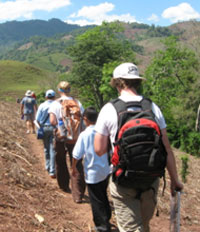
Once we had surveyed the aldea, we would conduct various group behavioral 'games,' the information diffusion game, mobilization game, and the election game. All of these games conclude at an aldea-wide meeting.
The mobilization game starts with several randomly selected individuals. These individuals, or mobilizers, are the only people told of the aldea-wide meeting. They are the ones who are to invite people to the meeting. For each person that they brought to the meeting, their name was entered into a raffle, meaning that the more people they personally bring to the meeting, the higher chance they have of winning the raffle prizeThis game gathers information about how the networks of influence works in getting a group of people to work together in the aldea.
The election game occurs at the aldea-wide meeting; it is simply an election by the people for a leader of the aldea to act as a UMF representative. This information helps draw the social hierarchies within each of the networks and emphasizes the relationships of influence.
In this game, we would randomly select several individuals in the aldea to participate. Each individual would be given a secret password, and he or she could tell the password to anyone he or she wanted. At the aldea meeting, this password could be entered into a raffle for a prize. The catch is, the individual first given the password has a better chance of winning the prize if he or she doesn't tell anyone else. But they may want to give someone close to them a chance of winning, in which case they would divulge the password. Through this game, we learn what relationships are most important, especially when it comes to economic decisions.
In the public goods game, 10 randomly selected members of the aldea are given an equal amount of money. For every round of the game, each member secretly elects to cooperate or defect; or this case, to put some money in the community pot, or keep it for themselves. And depending on how many people put money into the pot, each person will earn a return for a certain amount of money. If a minority of the group cooperates, each person will get back less than they put in. Except for those who defected, because they kept their money and still received the return on the pot. In this case, it would be better to defect. But, if a large majority of the group puts money into the community pot, they will receive a greater return than what they put in. In this case, it would be better to cooperate.
Essentially, this game shows either how cooperative or self-serving each of the communities are and the conditions in which it may vary. More so, it can show how people in different positions in the social network may be more cooperative or self-serving than those in other positions. Or it can show how different social make-ups of the groups lead to different outcomes over time. The most important outcome for UMF is to understand how to better work with communities and encourage cooperation.
Aldea Development is a 501(c)(3) nonprofit organization.
©2009–2026 Unión MicroFinanza Inc.