About La Unión
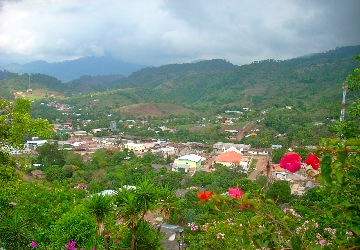
Unión MicroFinanza operates in La Unión, a municipality nestled within the mountains of Western Honduras in the Department of Lempira. La Unión is a municipality consisting of roughly thirty-two networked villages connected through a spiderweb of dirt roads leading to the town of La Unión itself. Here in La Unión, Unión MicroFinanza headquarters its microfinance and research operations. Over 6,000 people live in this town, a tightly knit community built upon the foundations of Christianity and agriculture. Throughout La Unión and the surrounding villages images of poverty are vivid.
The history of the land best explains the inequities in poverty, the focus on coffee production, and the culture that developed within La Unión and its surrounding aldeas in which we work. Though it’s interesting to delve into the colonial roots of this society and even the Meso-American pre-colonial civilizations, the story of La Unión is most easily understood beginning with the arrival of wealthy landowners coming from once Spanish colonial outposts.
Staking claim to the land, wealthy families literally drove stakes throughout these rolling mountain valleys and fenced the land they wanted to call their own. Lots of land, located high in nutrient rich green-forested mountains, with tropical yet cool seasonal temperatures made for ideal coffee growing conditions. Coffee, a commodity brought from the Old World, would become the region’s and country’s most powerful industry and exported good.
Though most farmers grow beans and corn to sustain their families for the year, everyone is involved with the coffee harvest. Few villagers have much land at all, and those with a few acres of land above and beyond what they need for grains grow coffee fields. The coffee culture and the history behind it has led to slow economic development for many, while the few large landowning families remain in economic and political power.
Recognizable cities such as Tegucigalpa and San Pedro Sula have met some standard of modernization levels. Still, stark difference between these cities and those of the United States exist, but significantly more so between larger Honduran cities and these rural mountain family villages. Imagine: electricity only arrived to the town of La Unión one decade ago, running water is sporadically available, health and educational institutions remain recently developed and under-resourced, as political inefficiencies challenge the development of this town.
Living conditions are worse in each village, with some villagers living in more dire situations than others. Access to electricity, water, healthcare, and education remains difficult. It is within these villages, ranging in size from 50 to 400 people, that we encourage microenterprises with loans, conduct research, and lead business and agricultural trainings. Additionally, we constantly bring service projects to the villages lacking the most basic necessities. Despite the poverty and lower standards of living, culture remains rich. Our mountain neighbors are deeply religious, love their soccer, and celebrate traditional festivals.
Differences in the level of development of the town of La Unión compared with its surrounding villages are very apparent. Health and education institutions are limited but available. Vida Abundante, the local evangelical church, constructed a bilingual school in 2003, where quality education is provided to sponsored and more fortunate children. Unión MicroFinanza works extensively with the older students as translators for our research and project efforts. Families are occasionally able to pay to attend this school, though many students attend by means of domestic and international sponsorships. Public schools exist for the rest of the children from kindergarten through high school, though education in the villages rarely exceeds elementary levels. In town, the public education system vocationally gears students towards either agricultural business administration or socioeconomic development. Unión MicroFinanza works with students as a graduation requirement through internship and research programs designed to put their education to practice.
The comparisons to make between here and where we each come from in the United States are innumerable. And despite the differences, life is pleasant here, people are warm, and though the poverty is shocking for newcomers, it is something each one of us working for Unión MicroFinanza believes we can influence. Certainly, political and institutional hurdles built from unique post-colonial histories make it difficult to navigate our best course of action, but we are learning how to operate within the existing system to help give the farmers we work with a leg up.
Though the description of La Unión does not do justice in describing the hardships faced by our clients, it is self-evident that Unión MicroFinanza fills a void created by economic inequality. Farmers here want to work, but do not have the means to reap the maximum benefits from the small lands they cultivate. With our help, they can grow more corn and beans to sustain their families, and come closer to reaching the maximum coffee output that one small piece of land can produce. We want to see the lives of our clients and their families improve. We want farmers to take pride in growing better crops with more bountiful harvests. These goals are achievable, but will not be achieved overnight. Through sustained rural development assistance, Unión MicroFinanza will enable our clients and their communities to elevate themselves to another, higher level of living.
Aldea Development is a 501(c)(3) nonprofit organization.
©2009–2026 Unión MicroFinanza Inc.